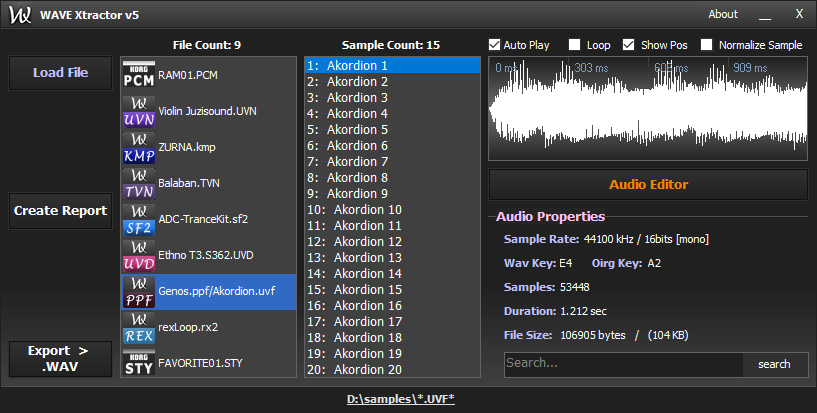
Extract .Wav sample data from KORG, Yamaha and other popular File formats.
Build: 02 January 2026
File Size: 5.20 MB

: Implementing supply-side reforms to improve long-term productive capacity. Monitoring
serves as a classic comprehensive text for the program design concepts typically found in Volume 2/Part 2, covering sectoral forecasting and adjustment programs. MEFMI Training Manual
Financial Programming and Policies, Part 2 (FPP2x) course and its accompanying materials from the International Monetary Fund (IMF)
Analyzes government revenue, expenditure, and the resulting financing gap.
Unlike standard economic textbooks that might focus on abstract equilibrium models, Volume 2 is distinct in its insistence on accounting consistency. It forces the reader to recognize that a fiscal deficit must be financed either by domestic credit creation (which impacts inflation and the money supply) or by external borrowing (which impacts the balance of payments and debt sustainability). This sectoral interdependence is the "engine" of the volume, driving home the lesson that no policy exists in a vacuum.
The PDF guides users through identifying "gaps." For example, if a country has a massive trade deficit and no foreign reserves, the program identifies exactly how much spending must be cut to stabilize the currency. 3. Policy Design This is the heart of Volume 2. It explores:
This will take you through PayPal, to complete the payment.
*approx €30 Eur
1 License [1 PC]
Free updates
Technical support
Refunds can only be accepted if you have not received your Activation Code.
: Implementing supply-side reforms to improve long-term productive capacity. Monitoring
serves as a classic comprehensive text for the program design concepts typically found in Volume 2/Part 2, covering sectoral forecasting and adjustment programs. MEFMI Training Manual financial programming and policies volume 2 pdf
Financial Programming and Policies, Part 2 (FPP2x) course and its accompanying materials from the International Monetary Fund (IMF) Unlike standard economic textbooks that might focus on
Analyzes government revenue, expenditure, and the resulting financing gap. The PDF guides users through identifying "gaps
Unlike standard economic textbooks that might focus on abstract equilibrium models, Volume 2 is distinct in its insistence on accounting consistency. It forces the reader to recognize that a fiscal deficit must be financed either by domestic credit creation (which impacts inflation and the money supply) or by external borrowing (which impacts the balance of payments and debt sustainability). This sectoral interdependence is the "engine" of the volume, driving home the lesson that no policy exists in a vacuum.
The PDF guides users through identifying "gaps." For example, if a country has a massive trade deficit and no foreign reserves, the program identifies exactly how much spending must be cut to stabilize the currency. 3. Policy Design This is the heart of Volume 2. It explores:
Social Media: